Dating Apps & Technology · 9 min read
Ghosting, Breadcrumbing, and Benching: Deciphering Modern Dating Terms
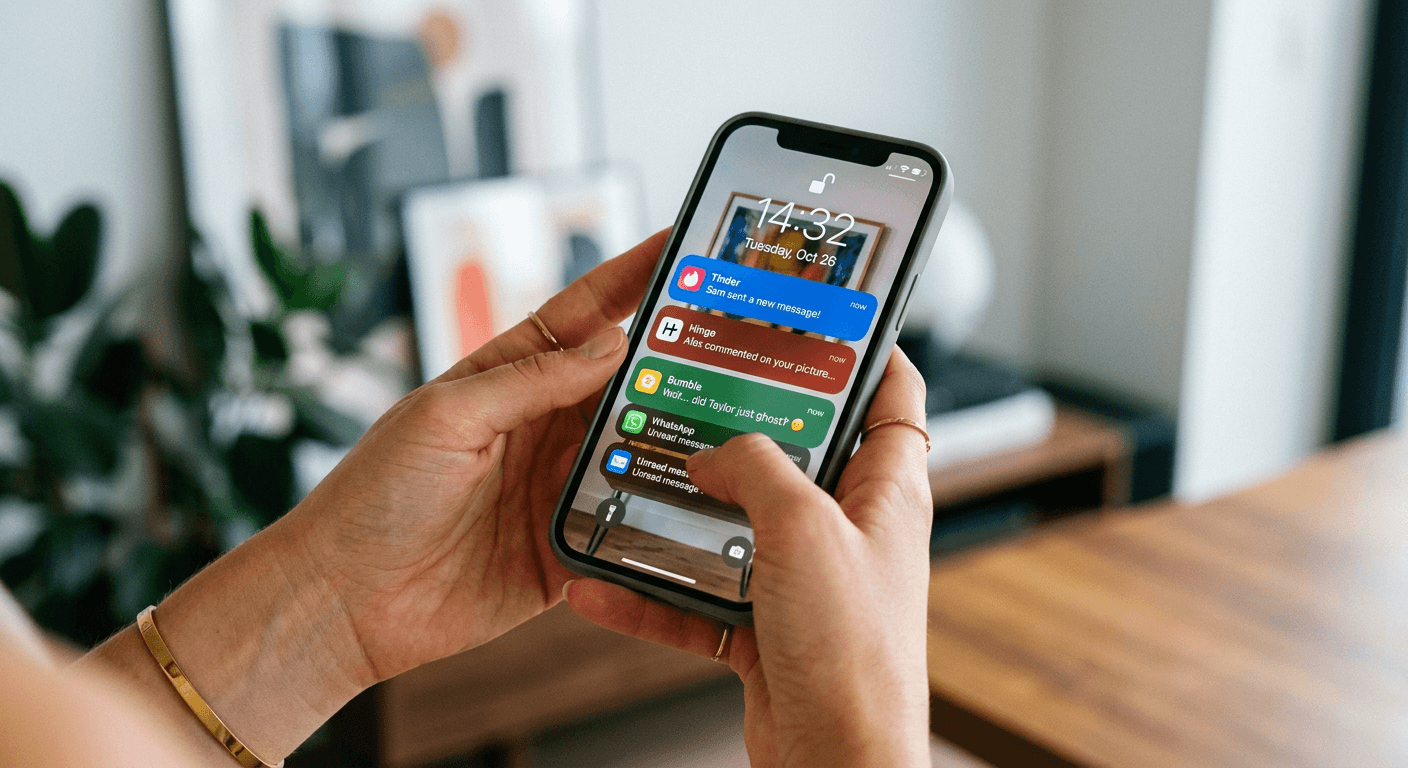
Navigating the digital dating world requires a new vocabulary. This guide deciphers the latest baffling behaviors and terms, helping you understand and cope with common app-related phenomena.
Arlin Cuncic · March 12, 2026
Our take
Let’s be real: dating in the era of the infinite swipe feels less like a romantic comedy and more like a linguistic puzzle you never signed up to solve. We’ve all been there—staring at a phone that hasn't buzzed in three days, wondering if we did something wrong or if we’re just being "breadcrumbed" into a state of perpetual waiting. At Next Boyfriend, we believe that clarity is your greatest superpower in the digital age, and understanding this new, often frustrating vocabulary is the first step toward reclaiming your agency. You aren't "too much" or "too intense"; you're simply navigating a landscape where communication has become increasingly fragmented, and it’s time we learn how to spot the patterns before they drain our energy.
Key takeaways
- The digital revolution has fundamentally altered the architecture of human intimacy.
- To protect your heart and your time, you must be able to distinguish between a genuine lapse in communication and a calculated pattern of behavior.
- It is easy to view these behaviors as personal attacks, but a broader look at the sociology of dating apps reveals a systemic issue.
- How do you tell the difference between someone who is genuinely busy and someone who is playing games?
The New Language of Connection and Confusion
The digital revolution has fundamentally altered the architecture of human intimacy. While dating apps have provided us with unprecedented access to potential partners, they have also introduced a peculiar, often demoralizing set of social behaviors that didn't exist in the era of landlines and coffee shop meetups. We are no longer just dealing with "playing hard to get"; we are navigating a complex lexicon of psychological maneuvers like ghosting, breadcrumbing, and benching.
For many women, these behaviors create a sense of "dating fatigue"—a state of emotional exhaustion caused by the constant cycle of connection and sudden disconnection. To navigate this, we must move beyond the frustration and begin to analyze these patterns through a psychological lens. Understanding the terminology isn't just about keeping up with internet slang; it's about identifying emotional unavailability before it costs you your peace of mind.
Decoding the Big Three: Ghosting, Breadcrumbing, and Benching
To protect your heart and your time, you must be able to distinguish between a genuine lapse in communication and a calculated pattern of behavior. Let’s break down the three most common phenomena currently plaguing the dating scene.
1. Ghosting: The Silent Exit
Ghosting is perhaps the most jarring of all modern dating behaviors. It occurs when someone you have been seeing—or even just texting—suddenly ceases all communication without any warning or explanation. One day you are sharing deep life philosophies, and the next, you are met with a digital void.
Ghosting is often a tool used by those who lack the emotional maturity to handle confrontation. Rather than saying, "I didn't feel a spark," or "I'm not ready for something serious," the ghoster chooses the path of least resistance: disappearance. While it feels deeply personal, it is almost always an act of emotional cowardice on their part, not a reflection of your desirability.
2. Breadcrumbing: The Digital Tease
If ghosting is a sudden disappearance, breadcrumbing is a slow, agonizing trickle of attention. Breadcrumbing involves sending sporadic, non-committal messages—a "thinking of you" text, a random meme, or a "how was your weekend?"—designed specifically to keep you interested without any real intention of following through with a date or a commitment.
Think of it as leaving a trail of digital crumbs to lure you back into their orbit whenever they feel lonely or bored. The goal of the breadcrumber isn't to build a relationship; it's to maintain a "placeholder" in your life to boost their own ego. It is a low-effort, high-reward tactic that leaves the recipient feeling perpetually "on the hook."
3. Benching: The Backup Plan
Benching is a more subtle and perhaps more insidious behavior. As Arlin Cuncic explores in her work for Verywell Mind, benching occurs when someone keeps you "on the bench" as a backup option. They aren't quite ready to commit to you, but they aren't ready to let you go either. They keep the connection just warm enough so that if their primary prospects don't work out, they have a reliable fallback waiting in the wings.
You might notice this when someone is incredibly charming when you are together, but they are consistently "too busy" to make actual plans, or they only reach out when their other social options fall through. It is the dating equivalent of being a "Plan B."
The Psychology of the Swipe: Why Does This Happen?
It is easy to view these behaviors as personal attacks, but a broader look at the sociology of dating apps reveals a systemic issue. The digital environment is characterized by "low stakes and high volume." When a person is faced with a literal infinite scroll of potential partners, the perceived "cost" of discarding a human being drops significantly.
The Paradox of Choice
Psychologist Barry Schwartz famously discussed the "Paradox of Choice," the idea that having too many options actually leads to increased anxiety and dissatisfaction. In dating apps, this manifests as a "disposable" mindset. If a first date isn't perfect, or if a conversation becomes slightly uncomfortable, the user can simply swipe to the next person. This abundance of choice makes it easier for individuals to avoid the "hard work" of communication.
The Anonymity Shield
The digital interface acts as a buffer. It is much easier to ignore a text than it is to look someone in the eye and say, "I'm not interested." This perceived anonymity reduces empathy. When we interact with a profile rather than a person, we often forget that there is a living, breathing human on the other side of the screen with real feelings and vulnerabilities.
Identifying the Red Flags in Real-Time
How do you tell the difference between someone who is genuinely busy and someone who is playing games? It comes down to consistency and intent.
- The Consistency Test: A person who is interested in you will make an effort to maintain a consistent rhythm of communication. If you find yourself constantly "interpreting" their silence or making excuses for their lack of engagement, you are likely being breadcrumbed or benched.
- The Intentionality Test: Does the communication lead to action? If someone texts you every day for two weeks but refuses to commit to a dinner date, they are breadcrumbing. If they only contact you on Friday nights when they have no other plans, they are benching you.
- The "How Do I Feel?" Test: This is your most important tool. After interacting with this person, do you feel energized and seen, or do you feel anxious, confused, and "less than"? Your nervous system often knows the truth before your logical brain does.
Practical Strategies: How to Protect Your Peace
Navigating these waters requires more than just awareness; it requires a toolkit of actionable boundaries. You cannot control how others behave, but you can control how much access they have to your heart.
Set Clear Expectations Early
Don't be afraid to state what you are looking for. While this might "scare off" the people who were only looking for something casual, that is exactly the goal. By being transparent about your desire for consistency and communication, you act as a natural filter for breadcrumbers and benchers.
The "Three-Strike" Rule for Communication
To avoid getting stuck in a cycle of waiting, implement a personal rule for digital engagement. For example, if someone flakes on a plan without a valid reason and a proactive attempt to reschedule, or if they disappear for a week and reappear with a low-effort text, consider that a strike. After three strikes, stop responding. You aren't being "mean"; you are being protective of your time.
Avoid the "Investigation" Trap
When someone ghosts or breadcrumbs, the temptation to go down a social media rabbit hole is immense. Don't do it. Looking at their Instagram stories to see if they are active while ignoring you will only deepen your sense of rejection. If they have the capacity to post a photo of their latte but not the capacity to text you back, you have your answer.
The Art of Non-Internalization
Perhaps the most vital piece of advice we can offer is this: Their behavior is a reflection of their character, not your worth.
When we are ghosted, our brains instinctively search for what we did "wrong." We replay the last conversation, analyze our outfit in the photos, or wonder if we were "too much." This is a cognitive distortion. A person's inability to communicate effectively is a deficit in their emotional toolkit. It has nothing to do with your value, your beauty, or your ability to be a partner.
Think of it this way: If someone refuses to play a game because they don't know the rules, you don't blame the board; you recognize that they aren't ready to play.
Reclaiming Your Dating Agency
Dating in the modern age is undeniably harder than it used to be, but it is not impossible. The goal is not to find a person who never makes mistakes—everyone has bad days and lapses in judgment—but to find a person whose communication style aligns with your need for respect and clarity.
By learning these terms and understanding the psychological drivers behind them, you transition from a passive participant in the dating "game" to an active curator of your own romantic life. You are no longer a victim of the algorithm; you are a woman who knows her worth and refuses to settle for crumbs when she deserves a feast.
Final Thoughts: Focus on Self-Care and Growth
As you navigate the highs and lows of the app-driven dating world, remember to pour that energy back into yourself. The most stable relationship you will ever have is the one you have with yourself.
When you experience the sting of being benched or the confusion of a ghosting, use it as a prompt for self-care. Reconnect with your hobbies, spend time with friends who make you feel seen, and remind yourself of the qualities that make you an incredible partner. The right person won't make you feel like you're solving a riddle; they will make you feel like you've finally come home.
Questions about Dating Apps & Technology
Which dating app is best?
It depends entirely on your goal. Apps skew differently by intent, age, and region — some toward serious relationships, some toward volume and casual meeting. Match the app to your goal rather than joining whichever is largest, and read platform-specific reviews before investing time.
How do dating app algorithms work?
Most rank profiles using a desirability score derived from how people who have swiped on you behave, then show you profiles with similar scores. Activity matters too: recent, frequent, selective users generally get more visibility than dormant accounts that like everyone.
Why do I get so few matches?
Usually photos and specificity, in that order. Clear, well-lit, face-forward lead photos outperform group shots and filtered images, and profiles with concrete detail give people something to respond to. Swiping selectively rather than mass-liking also improves how the algorithm ranks you.
Keep reading
- Guide: The Intentional Dating Guide: How to Date with Purpose, Not Just Hope
- Guide: Rebuilding Self-Worth: How to Stop Settling and Start Choosing

Dating Apps & Technology
Is Romance That Begins Online Less Fulfilling?
Is Romance That Begins Online Less Fulfilling? How to strengthen a relationship regardless of how it began. - The Science of Mating Too Many Choices One of the most well-known…
Summary of Psychologytoday · 8 min read

Dating Apps & Technology
Dating App Statistics (2026): Market Growth, User Behavior, and AI Trends
Dating App Statistics (2026): Market Growth, User Behavior, and AI Trends 10 min read Frank L. TLDR; With global revenue for dating apps projected to reach $3.24 billion in 2026…
Summary of Getstream · 15 min read

Dating Apps & Technology
Principal Data & Analytics Strategist - Mayo Clinic Careers
Leveraging Enterprise Architecture to construct integration centricity, promote data liquidity, and provide innovation support. This transformation creates, ...
Summary of Jobs · 10 min read
Comments
No comments yet.